My recent pearl tour of Japan offered me not only an introduction to the world of akoya pearls, but also gave me a fully immersive, 360-degree view of the journey of cultured pearls, from pearl farms to the global jewellery market.
As part of our itinerary, we visited Otsuki Pearl Co. Ltd. in Kobe, where I witnessed, first-hand, key aspects of post-harvest cultured Akoya pearl processing, including both sorting and drilling.
Founded in 1930, the Otsuki Pearl Co. has long stood at the forefront of Japan’s cultured pearl industry. Today, it is one of Japan’s leading processors and exporters of top-quality cultured pearls.
Each year, the company processes approximately 130 kg of freshly harvested pearls, which, to put into perspective, is enough to create roughly 4,000, 18-inch necklaces. While certain parts of the pearl processing have become mechanized, the company continues to rely on their highly trained technicians for the critical task of sorting the pearls.
Inside the Pearl Sorting and Drilling Room at Otsuki Pearl Co.
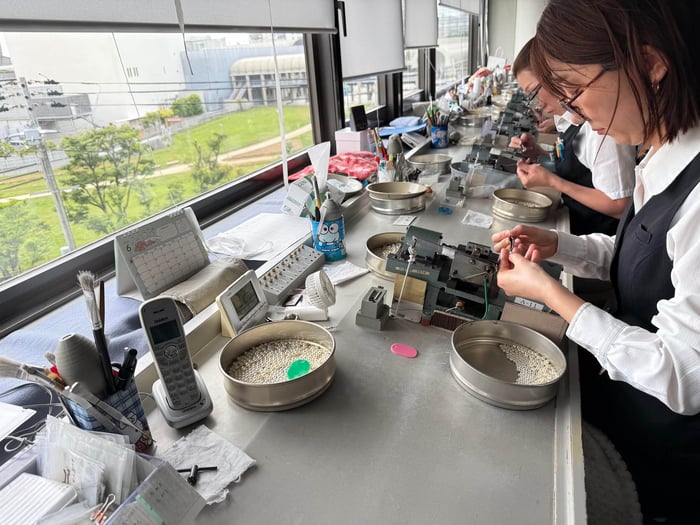
At first glance, the room felt quiet. Technicians worked at their stations, facing a wall of windows where natural light poured in, an essential element for accurately sorting pearls. As onlookers, we felt it would be rude to talk in anything but the softest whispers.
The technicians worked with seamless efficiency. Decades of experience have refined this workflow at Otsuki. A pearl would be picked up and rolled between the index finger and thumb to assess its shape and surface flaws. Another would be lifted with a bamboo tweezer and gently rolled across a grey felt work surface to evaluate its colour, lustre, and nacre thickness. Each movement reflected years of training and deep expertise.
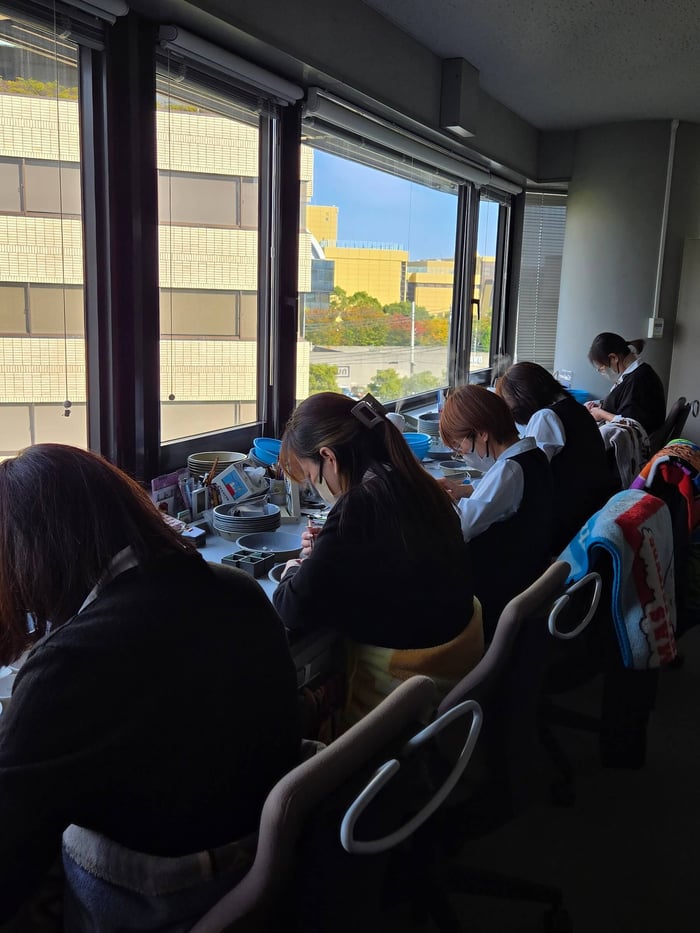
What stood out most to me was the serenity of the work. There was no sense of rush. The focus was entirely on precision, guided by an almost intuitive understanding of both the gem and the process.
At Otsuki Pearl Co., all the technicians are trained in-house. Most undergo at least three years of training, though the learning never truly ends. On average, each technician sorts between 10,000 and 20,000 pearls a day.
Pearl Drilling and Sorting
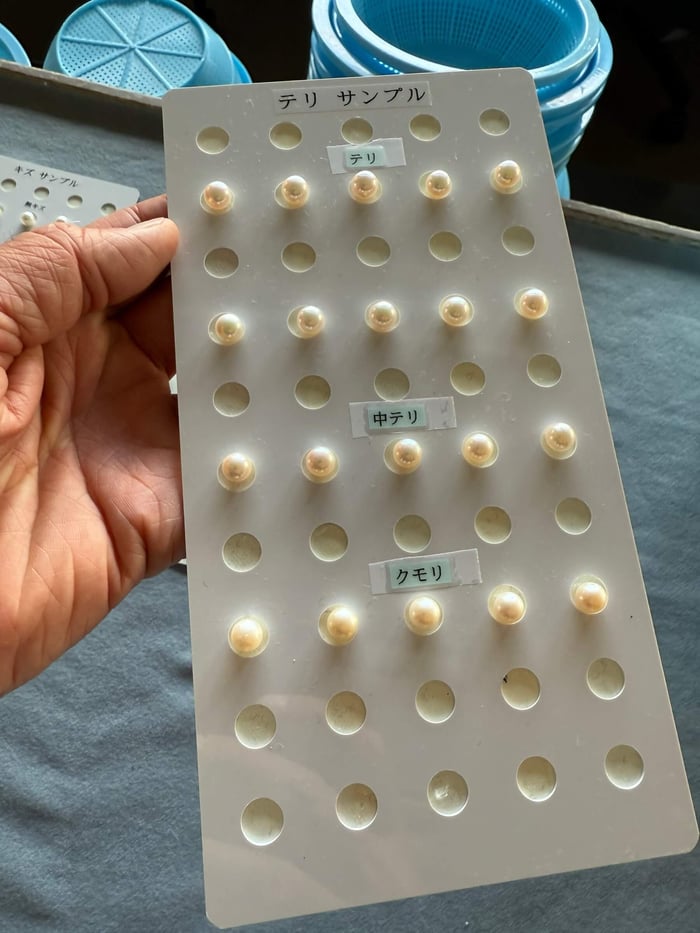
The company maintains its own master sets to guide the sorting process. Some masters are set up for grading according to size, nacre (maki), luster, shape, surface flaws and color, with particular attention to shape and flaws. Initially, all pearls are sorted for intended use - earrings, rings and necklaces.
As pearl enthusiasts, we were particularly thrilled to have been given this opportunity to not only see these masters but to photograph them as well.
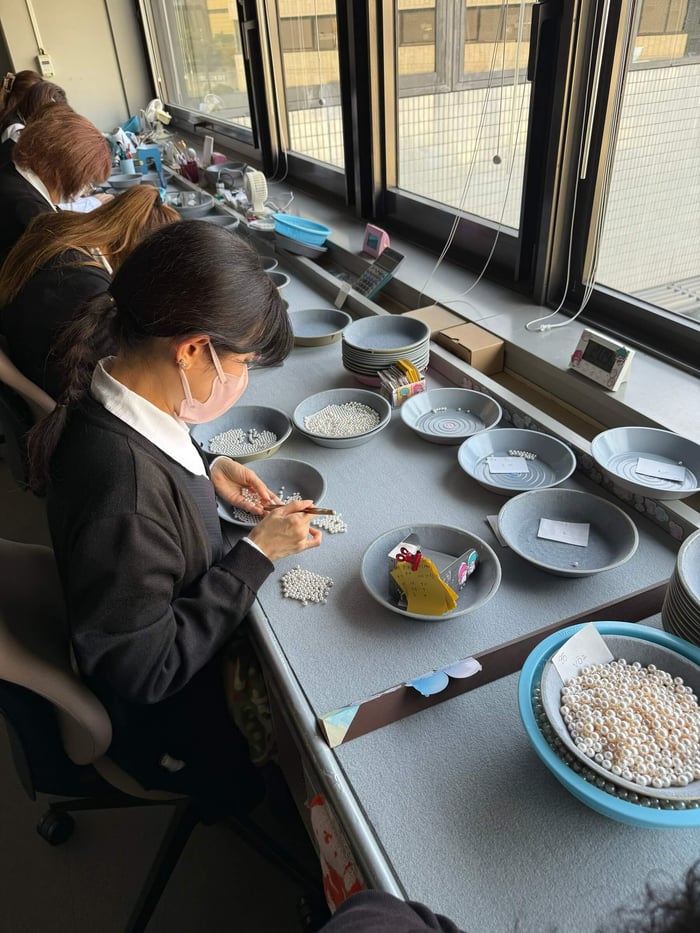
The pearls that are set aside for necklaces are then mechanically drilled. After close examination, the technician uses metal tweezers to place the pearl in the machine. Once the pearl is secured, the drill is activated. The drilled pearl is then collected in another container.
Once drilled, the pearls are sorted for pearl strands. This sorting process divides the pearls according to size, shape, luster and surface blemishes. Akoya pearls go through multiple sorting before they are strung into temporary necklaces.
First, the technicians sort the pearls by size, using a sieve-like tool.
Grouped into different sizes, the pearls are then sorted for nacre thickness. The technicians are trained to spot thicker nacre, which gives the pearls a deeper and more luminous shine.
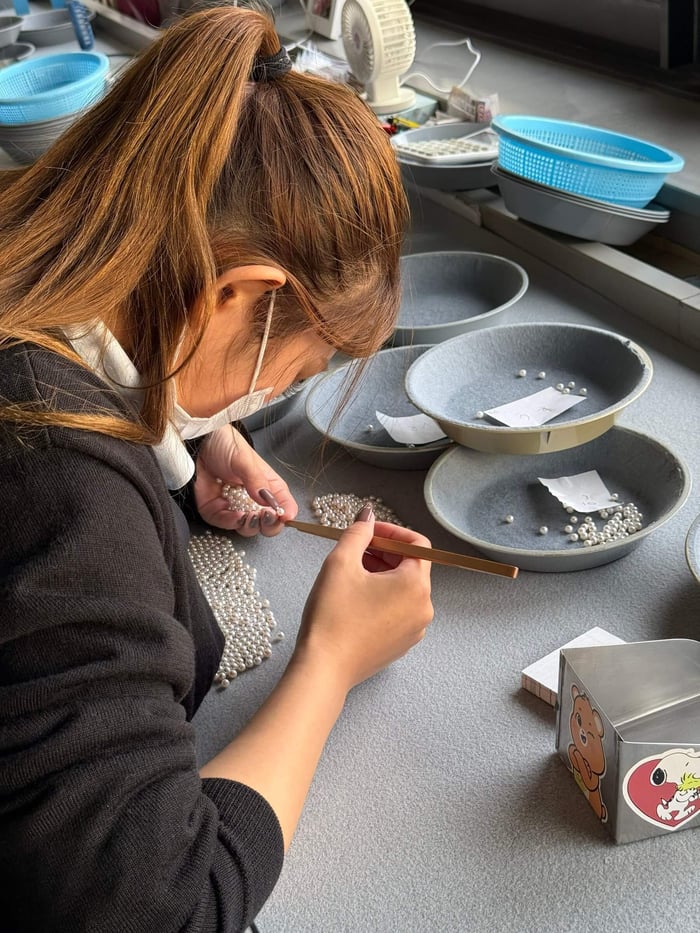
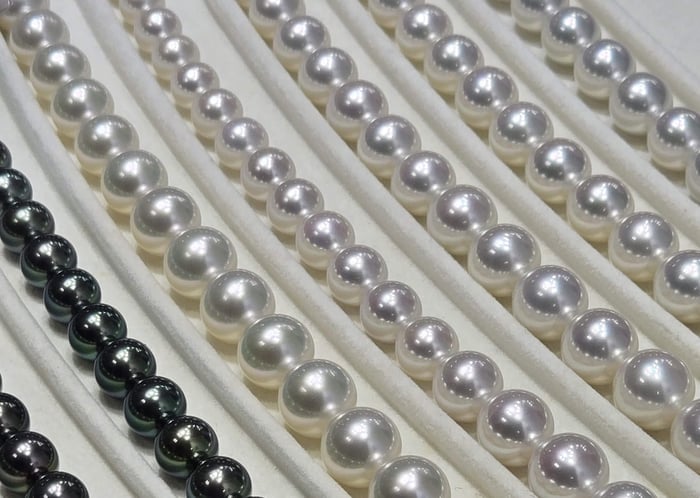
Then the pearls are sorted for color and overtones. Akoya pearls typically display four different overtone hues - white, cream, pink and blue. Among these, the blue hues may be very subtle. Hence, the pearls go through several rounds of sorting to ensure that even the softest hints of color are correctly recognized.
Next, the pearls are sorted according to luster, with those of similar reflective quality grouped together in preparation for stringing. At this stage, meticulous attention is required, as pearls are laid out and carefully compared to ensure uniformity across the entire strand in terms of size, color, luster, shape, surface quality, and nacre thickness.
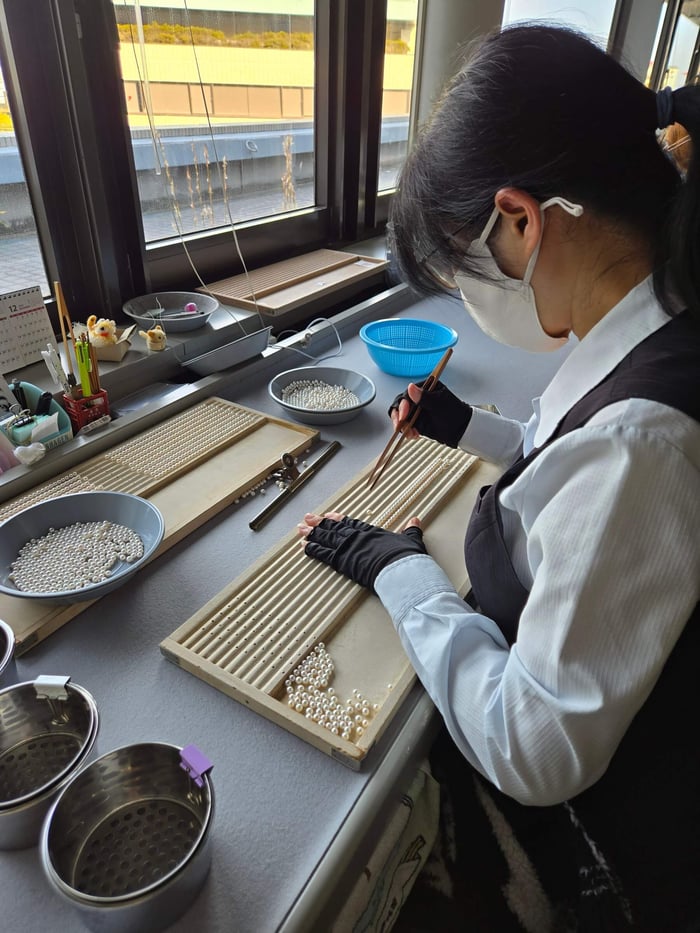
Finally, the matched pearls are strung into temporary necklaces. Strands of similar quality are then bundled together and prepared for wholesale distribution to both domestic and international buyers.
As our visit came to an end, the room left a lasting impression on all of us. This was not just because of the beauty of the pearls, because of the room was the perfect metaphor for quiet dedication to craft.
Pearl necklaces may begin their journey on farms, but it is within the sorting and drilling room at Otsuki Pearl Co. that loose pearls are meticulously shaped into the refined elegance we ultimately see.