
Pearl education · Pearls As One
Akoya Pearls: Luster, Cultivation, and Character
Understand the pearl behind the classic strand, from its Japanese culturing history to the sharp reflections that distinguish fine examples.
4-minute read
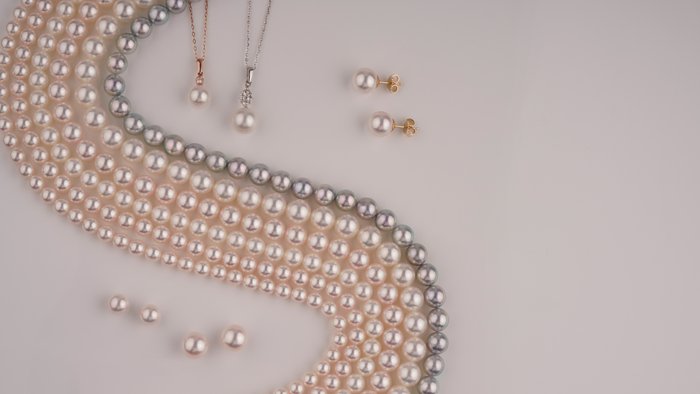
- Environment
- Saltwater
- Mollusk
- Akoya pearl oyster, Pinctada fucata group
- Principal source
- Japan; also grown in other regions
- Familiar appearance
- White or cream, often with subtle overtones; natural silver-blue colors also occur
What makes a pearl akoya?
Akoya describes a cultured pearl produced by an akoya pearl oyster, a marine mollusk in the Pinctada fucata group. Japan is the principal producer and the historical center of the category, with cultivation also established in places including China and Vietnam. An akoya pearl is not defined simply by being small, white, or round. Some freshwater pearls closely resemble it, and genuine akoya pearls include colors and shapes beyond the familiar white strand.
Size is one useful point of comparison. Many akoya pearls encountered in jewelry measure around 6–8 millimeters, although smaller examples are common and exceptional pearls can exceed 10 millimeters. These are descriptive ranges, not identification rules. The pearl type and the actual measurements should both appear in a useful description.
Further reading: GIA: “Freshwater Akoyas” — A Trending Misnomer
How Japan changed the pearl world
Akoya farming helped make pearls available far beyond the natural-pearl trade. Kokichi Mikimoto's successful cultured blister pearls in 1893 were attached to the shell rather than free, round pearls. The later development of whole-pearl cultivation depended on work by several pioneers, notably Tatsuhei Mise and Tokichi Nishikawa, and on the use of donor mantle tissue together with a bead nucleus.
This distinction matters: the achievement was not merely placing a bead inside an oyster. It was establishing living, nacre-producing tissue around that bead. Japanese farmers, technicians, processors, and matchers refined the process into an industry, and the carefully matched akoya necklace became one of its defining products.
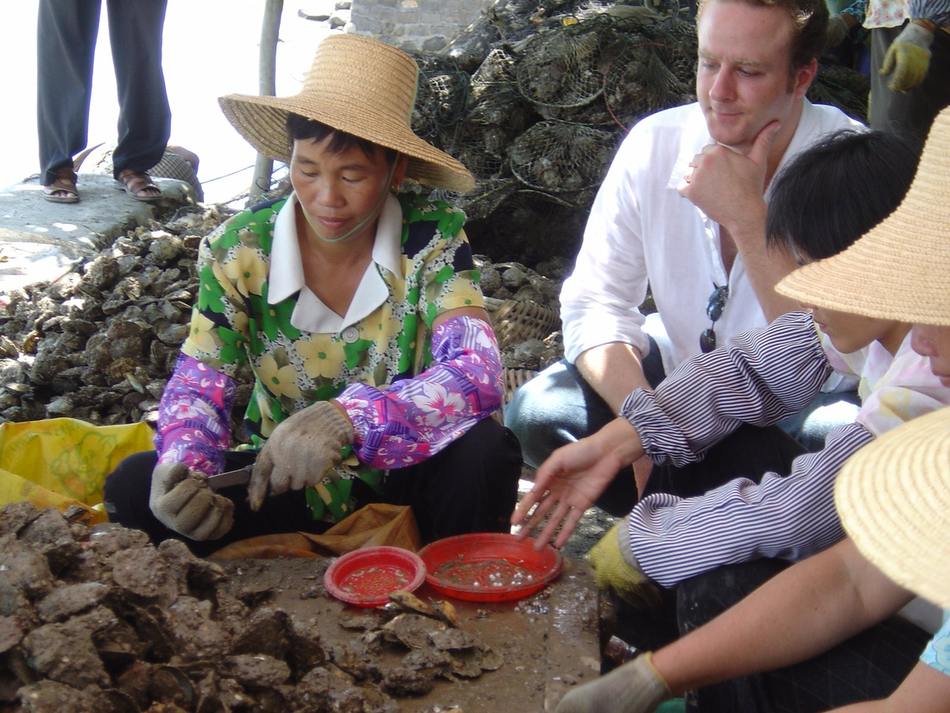
A bead, a graft, and living nacre
For typical bead-cultured akoya production, a skilled technician inserts a shell bead and a small piece of donor mantle tissue into the host mollusk. Cells from the graft establish a pearl sac that deposits nacre around the bead. The bead supplies a starting form; it does not produce the luminous outer layers.
After grafting, the mollusks recover and remain in the water under farm care. Water conditions, food availability, temperature, health, and the quality of the graft all influence the result. Farmers clean shells and equipment and manage the risks of storms, disease, and changing conditions. A round bead does not guarantee a round, lustrous pearl, and an extended growing period does not guarantee quality by itself.

Learn to see akoya luster
Fine akoya pearls are especially admired for bright, well-defined reflections. Look at a reflected window or another clear light source: are its edges distinct, or do they spread into a diffuse patch? Compare pearls of similar size in the same lighting, turning them so you see more than one attractive face.
Luster and nacre quality are related, but they are not interchangeable measurements. A bright photograph cannot establish nacre thickness. Nor is thickness alone a complete quality assessment: the condition and structure of the nacre affect what the eye sees. Examine surface marks, overall shape, and matching as well as brightness.
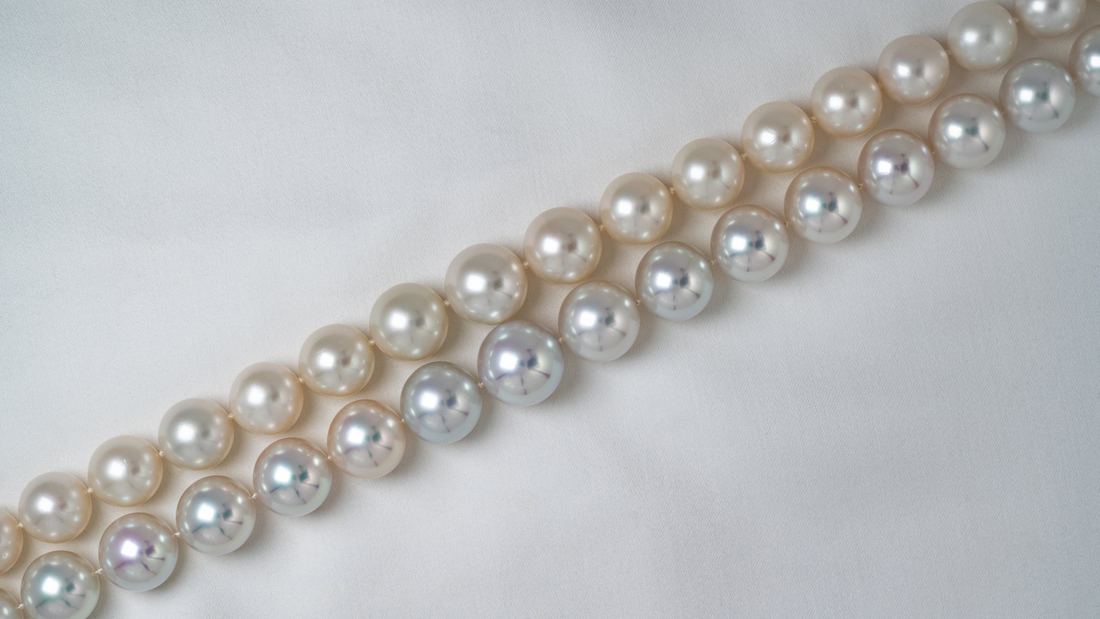
White is familiar, but not the whole palette
White and cream akoya pearls may show rose, silver, or other subtle overtones. Natural silver-blue bodycolors also occur, often in baroque pearls. An irregular shape can create especially interesting reflections and shifting color; it is not a different pearl type.
Post-harvest processing is common. Bleaching can make bodycolor more uniform, and pinking can adjust a delicate rosy appearance. Natural-color material also exists. Neither a pink overtone nor a blue bodycolor proves a particular treatment history. Ask for a clear statement about color and known processing rather than relying on a color name.
Grades, hanadama, and useful questions
Commercial labels such as AAA do not have one meaning across sellers. Hanadama is a recognized quality designation associated with fine akoya pearls, but it is not a separate species or an assurance that all pearls carrying the term are equivalent. When a report accompanies a strand, identify the issuing laboratory, the actual criteria, and the specific pearls examined.
For example, GIA requires its highest luster category for a hanadama comment, together with a white bodycolor, round or near-round form, little or no surface spotting, strong matching when applicable, and adequate nacre. This is a defined combination of characteristics, not a nacre-thickness label.
A well-matched strand requires agreement in luster, bodycolor, overtone, shape, and size progression. A larger strand with uneven brightness may be less visually coherent than a smaller, carefully assembled one. Compare the pearls themselves and ask questions the description can answer.
- Are these saltwater akoya cultured pearls, and what origin is documented?
- What are the millimeter measurements and the known treatment history?
- What does the seller's grade mean, and which characteristics does it evaluate?
- If there is a laboratory report, what conclusions does it actually state?
Further reading: GIA: Hanadama Quality Range Comment

Bring it together
Key takeaways
- Akoya identity comes from the mollusk and marine cultivation, not a white, round appearance.
- Sharp luster is an important quality, but nacre, surface, and matching deserve separate attention.
- A trade designation is most useful when its criteria and documentation are clear.
Go deeper with Pearls As One.
This public resource introduces the principles. The full course explores the biology, history, cultivation and evaluation of pearls in greater depth.