
Pearl education · Pearls As One
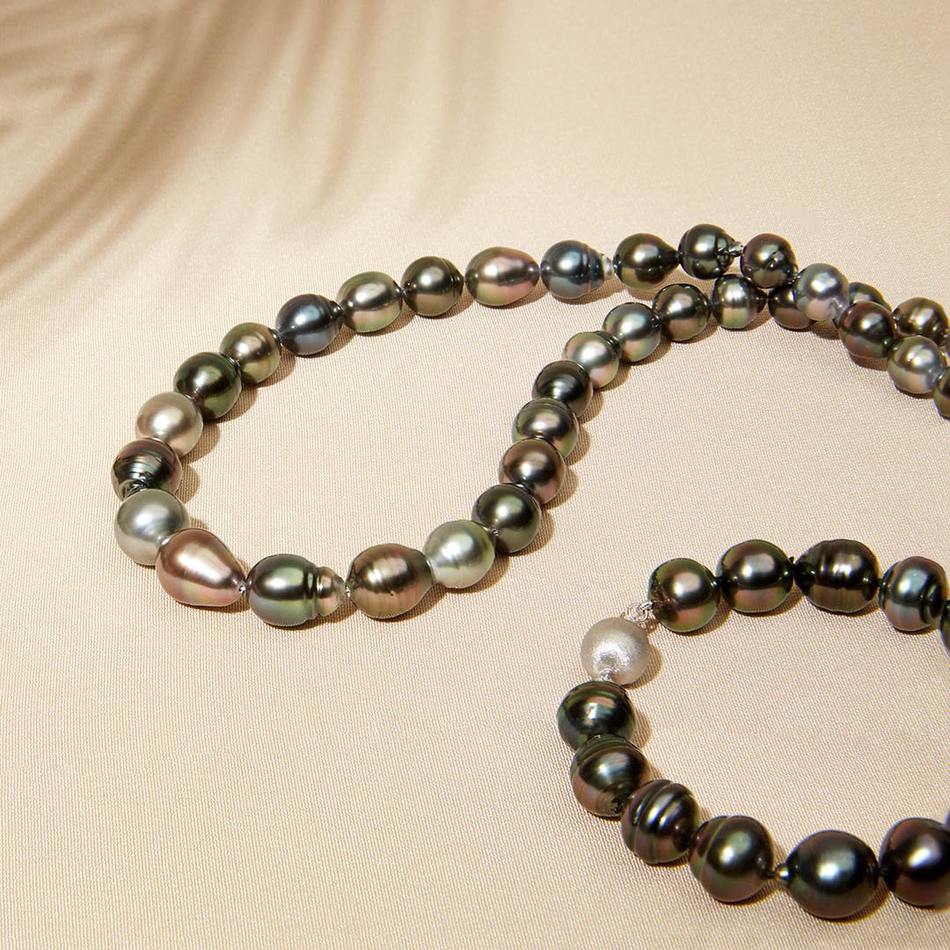
Tahitian Pearls: Understanding the Color
The famous black pearl is rarely simply black. Its identity connects a particular mollusk, French Polynesian farming, and a remarkably varied palette.
4-minute read
- Environment
- Saltwater lagoons
- Origin
- French Polynesia
- Mollusk
- Black-lipped pearl oyster, Pinctada margaritifera
- Typical scale
- Often about 8–13 millimeters; larger and smaller examples occur
A pearl defined by more than darkness
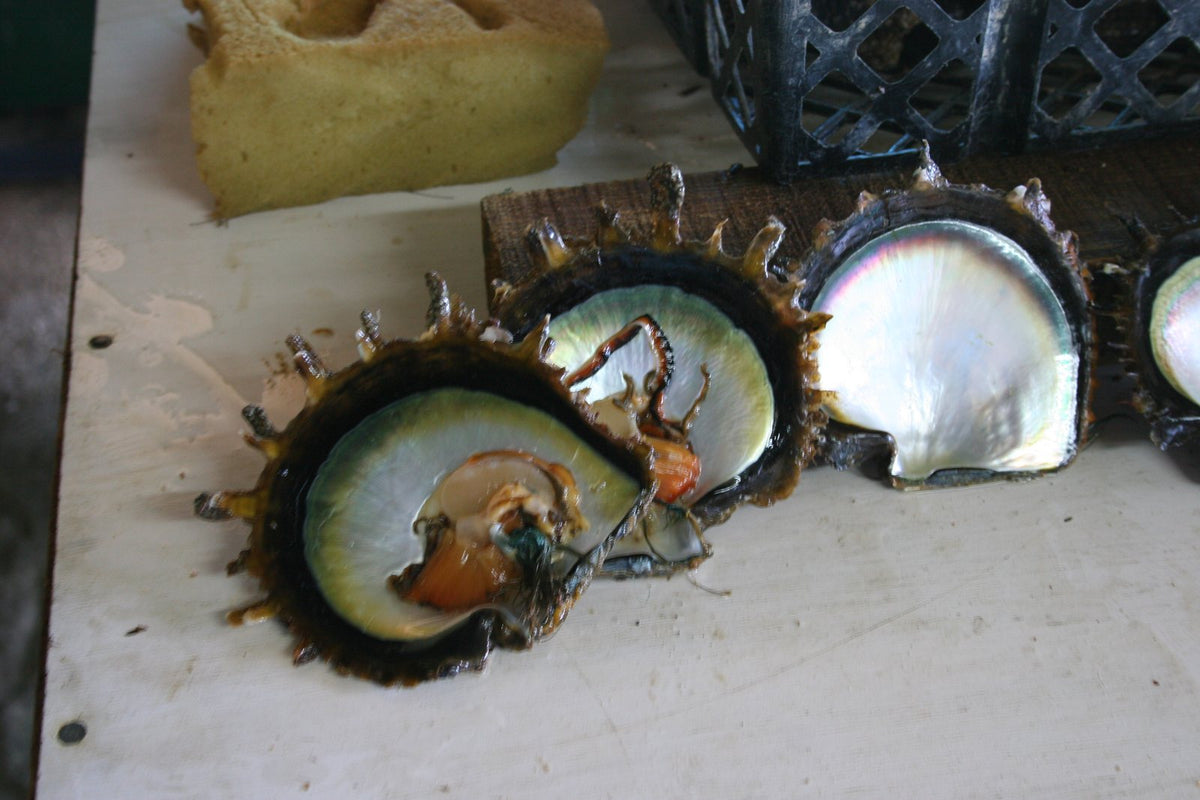
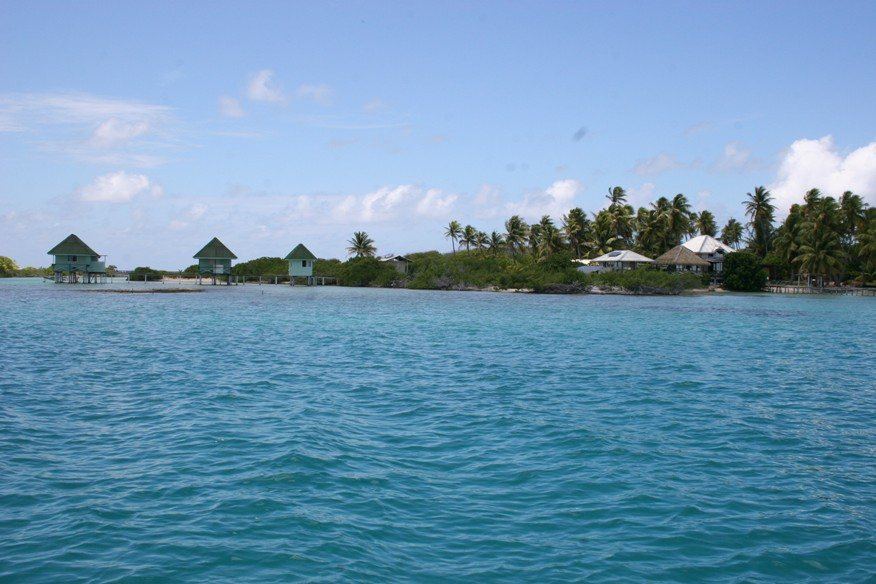
Tahitian cultured pearls are grown in French Polynesia in the black-lipped pearl oyster, Pinctada margaritifera. Tahiti is the best-known name and a trading center, but much of the farming takes place elsewhere in the territory, including the Tuamotu Archipelago and Gambier Islands. A reference to Tahitian pearls does not mean every pearl was grown beside the island of Tahiti.
The name also does not encompass every dark pearl. Pearls from Fiji have their own origin and farming identity. Cultured pearls from Mexico's Sea of Cortez include those from Pteria sterna, the rainbow-lipped pearl oyster, a different mollusk. A dyed freshwater pearl may also look dark. These distinctions should remain visible in an accurate description.
Further reading: GIA: Cultured Pearls from the Gulf of California, Mexico
How dark pearls became an established category
Natural dark pearls were known before farming, and the black-lipped shell was valued for mother-of-pearl. Successful culturing work in French Polynesia during the 1960s helped establish a new commercial pearl category. As production developed, another challenge was convincing an international market accustomed to white pearls that this color could occur naturally.
That history explains why natural color matters in the category. It does not mean that every dark pearl offered for sale is untreated or Tahitian. Pearl identity and the origin of its color are separate questions, and both need an appropriate basis.
Read color in three layers
Bodycolor is the pearl's overall color impression. In Tahitian pearls it can range from pale silver and gray to charcoal, with green, brown, or other hues contributing to the appearance. Overtone is a secondary color seen over that bodycolor. A gray pearl may carry green, rose, or violet effects that become more obvious as you turn it.
Orient describes an iridescent play of colors rather than one fixed hue. Not every fine pearl displays strong orient, and an overtone should not automatically be called orient. The common term peacock generally suggests a combination of green and pinkish or reddish effects on a darker pearl, but sellers do not all apply it identically. Look at the pearl rather than treating the word as a grade.
Very dark is not automatically better. A lighter silver pearl with lively luster and attractive overtone can be more compelling than a nearly black pearl with dull reflections. Color preferences also differ. Quality assessment should acknowledge the brightness, surface, shape, size, and matching that accompany a particular color.
From lagoon to harvest
Tahitian farming commonly uses a shell bead and a small graft of donor mantle tissue. The graft supplies the cells that establish the pearl sac; the sac deposits nacre around the bead. Donor selection contributes to the pearl's eventual appearance, but biology and growing conditions keep the outcome variable.
Mollusks are cared for in marine farm systems, where clean water, food supply, temperature, and circulation matter. Farmers clean shells and equipment and protect stock through a long growing cycle. Some healthy mollusks can be used for another pearl after harvest. This is a living aquaculture process with losses and uncertainty, not the manufacture of identical objects.
Shape, size, and matching
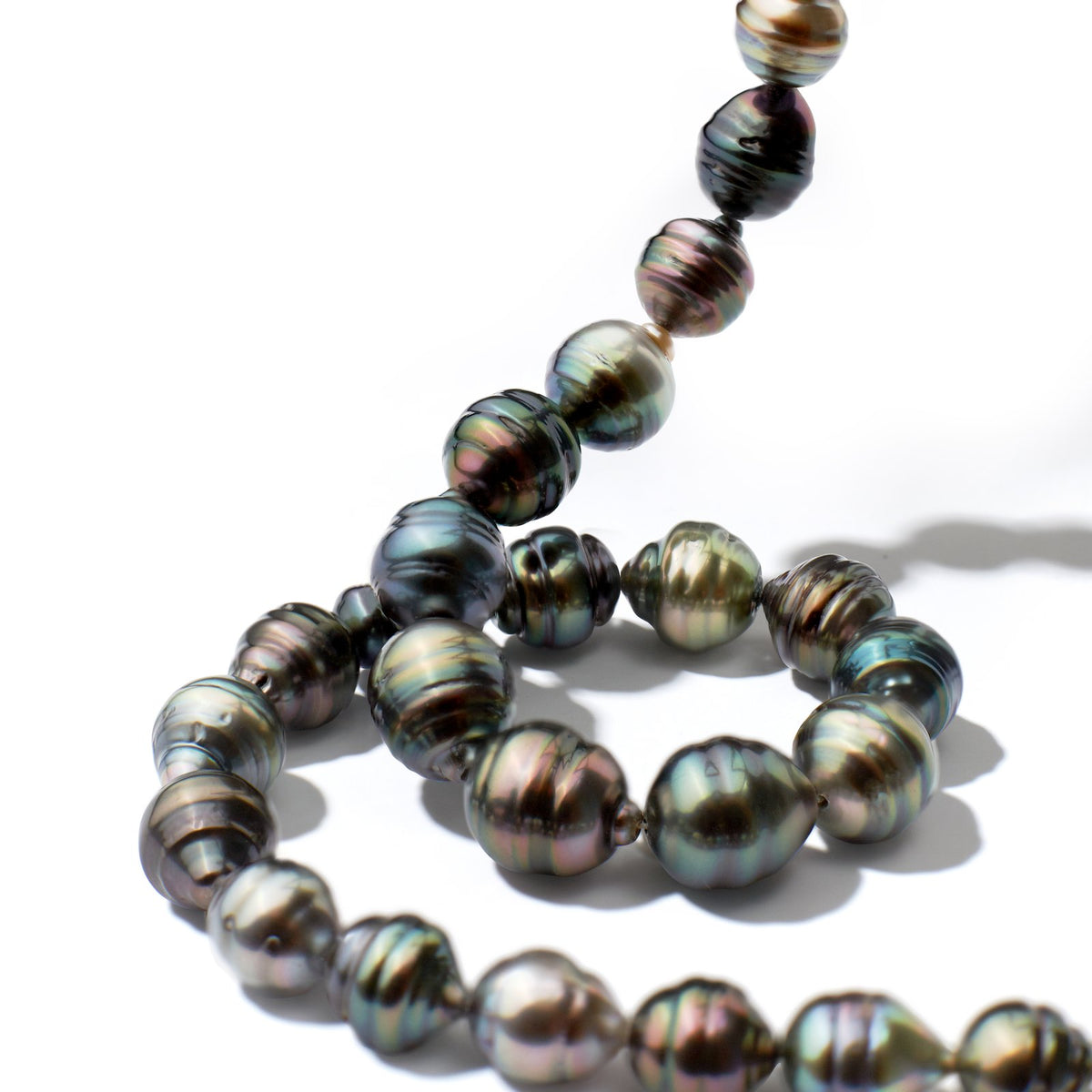
Tahitian pearls are often encountered around 8–13 millimeters, with examples outside that range. Round pearls are familiar, but drops, ovals, baroques, and circled pearls are important parts of the harvest. Circled pearls show ring-like grooves around the body; the circles are growth features, not proof that a pearl is imitation.
Study shape independently from surface condition. A deliberately chosen circled drop can be attractive and lustrous, while an apparently round pearl may have conspicuous pits or dull patches. For earrings, the balance between two pearls can matter more to the finished design than either pearl's individual symmetry.
Matching does not always mean identical color. A multicolor strand can be deliberately arranged so its shifts feel balanced. Compare the overall rhythm of size, brightness, and color, then look for a pearl that unintentionally breaks the pattern.
Questions that lead to a useful description
Ask for French Polynesian origin where the Tahitian name is used, an explanation of any claimed natural color, and known treatments. A laboratory report can help with identity and detectable treatment questions, but it should be read for its actual conclusions. A color photograph cannot establish a farm, island, or complete treatment history.
- Does Tahitian identify documented origin, rather than simply a dark appearance?
- Which words describe bodycolor, overtone, shape, and surface?
- Is the strand meant to match closely or to show an intentional color progression?
- What supports any treatment or provenance statement?
Bring it together
Key takeaways
- Tahitian is a French Polynesian pearl identity, not a synonym for every dark pearl.
- Bodycolor, overtone, and orient describe different aspects of appearance.
- Fine lighter pearls and expressive non-round shapes belong fully within the category.
Go deeper with Pearls As One.
This public resource introduces the principles. The full course explores the biology, history, cultivation and evaluation of pearls in greater depth.